
Car@s Amig@sAo fim de um ano de experiência, decidimos interromper a actividade do blog Estado Vigil.Os vários projectos profissionais em que nos encontramos envolvidos não permitem a atenção devida (como aliás tem sido evidente).Preferimos, por isso, suspender o blog, embora deixando para consulta os textos anteriores.Um abraço a todos, e obrigado pela vezes que cá vieram,Adalberto Campos FernandesJoão Varandas FernandesPedro Pita Barros
não temos escrito aqui, mas não estamos parados

Debates: A saúde um ano depois da troika – 3. Economia e Saúde
(post gémeo com o blo momentos económicos)
O último debate da série de três realizados sobre saúde na Livraria Ferin ocorreu ontem, 6 de Junho, tratou de Economia e Saúde, tendo como convidados Henrique Medina Carreira e Francisco Ramos. Segue-se um relato e leitura pessoais do que foi discutido, e com o qual os leitores e os presentes podem ou não concordar.
A pergunta lançada para discussão foi simples: qual o estado da situação, um ano de troika depois?
A intervenção de H Medina Carreira colocou na frente de discussão o contexto de toda a despesa pública, com um crescimento histórico sustentado da despesa pública ao mesmo tempo que se tem um menor crescimento ou mesmo decréscimo da actividade económica.
As pensões constituem uma pressão tremenda para o crescimento das despesas sociais. Das outras despesas sociais, apenas a educação teve uma compressão, com tudo o resto a aumentar também.
É o euro o problema? Não é o euro, na visão de Medina Carreira, e sim a desindustrialização das economias do ocidente, com a passagem para a produção de serviços desqualificados. Mesmo “consertando” o euro, não vai ser suficiente. “Vamos ter políticas sociais decrescentes.”
E com o decréscimo da produção, caso se mantenha, a redução das politicas sociais não vai ser compensada com acréscimo de despesa privada – se não há produção, não há rendimento.
A sugestão de Medina Carreira é que o modelo não tem solução, e para procurar uma solução é necessário um ministro que trate de todas as politicas sociais de forma integrada.
Os cortes a olho não são uma ideia de reforma e limita-se a deixar tudo descaracterizado. Tem que se olhar para o sistema social de uma forma que faça escolhas entre áreas de intervenção, dado o dinheiro que vamos ter.
Francisco Ramos, por seu lado, centrou-se na área da saúde, e sobretudo no sentimento de injustiça, que tem diversas faces, de quem está na saúde face ao que se está a passar.
A primeira face desse sentimento de injustiça está associada com a dimensão do esforço que é pedido a cada um dos sectores – porque não um capítulo especial do dinheiro da troika para financiar a saúde, tal como se fez com o sector bancário? Reduzir a despesa pública não deve ser independente do comportamento no passado recente e nesse passado recente (última década) as despesas públicas com saúde não cresceram muito.
A segunda face de injustiça referida por Francisco Ramos está ligada a que nem todas as medidas no Memorando de Entendimento têm tido igual aplicação, dando como exemplo a ADSE, referindo que esta é uma escolha de onde cortar que constitui também um sinal político.
Referiu que há um conjunto de oportunidades na redução de custos de factores de produção (trabalhadores, medicamentos, transportes, serviços privados prestados ao serviço nacional de saúde); já quanto à reforma hospitalar exprimiu dúvidas sobre o seu ritmo, embora reconheça que fazer tudo bem e depressa não é possível. Espera também que não seja uma oportunidade perdida em termos de foco na análise da efectividade das tecnologias.
Reconhece que não há uma resposta clara e satisfatória para o caminho do sistema de saúde ser sustentável, uma vez que não há mesmo num contexto internacional uma resposta de como se ter um sistema de saúde de qualidade e com acesso universal sem crescimento dos custos.
Da discussão realizada com a audiência, resultaram algumas ideias – não há um país que possa servir de referencia; que temos de ver o que há disponível e partir daí para a definição do modelo de saúde; que não podemos desprezar o ponto de partida.
Livraria Ferin – 6 Junho (Quarta-feira)
6 de Junho, 18h30
Livraria Ferin, debate com Henrique Medina Carreira e Francisco Ramos, 1 ano depois da troika no campo da saúde

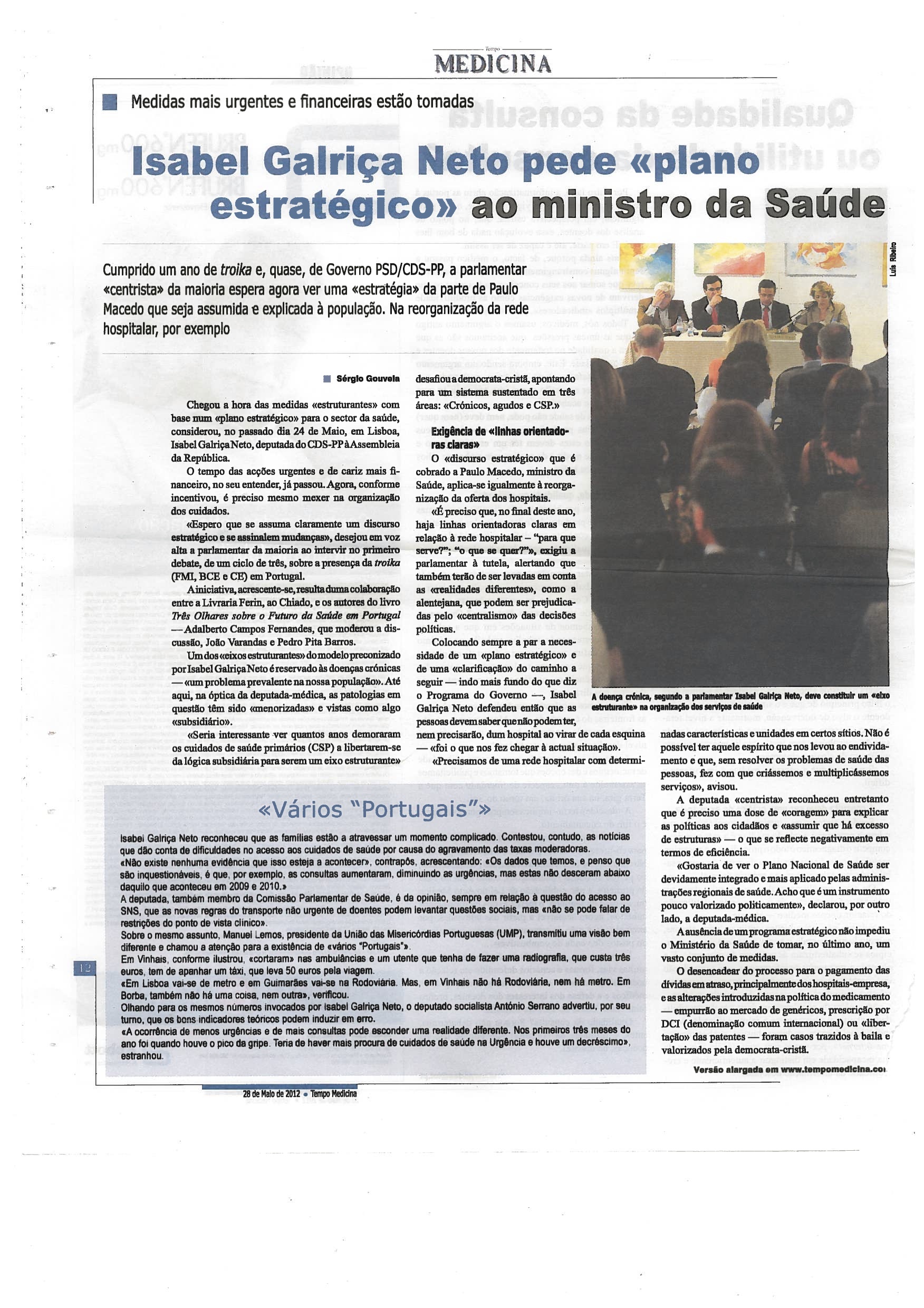
do debate da semana passada, no tempo medicina
convite 31 de maio, 18h30

A Politica da Saúde – primeiro debate da tertúlia “1 ano depois da troika”
 Decorreu quinta-feira passada a primeira de três sessões:
A Política da Saúde
Moderador: Adalberto Campos Fernandes, pergunta de abertura: temos razões para estar satisfeitos com o primeiro ano da troika?
As respostas: não há razão para grande alegria, dado o motivo da existência da troika.
Para estarmos mais satisfeitos, devia-se ver o tratamento e acompanhamento da doença crónica. São muitas medidas. A maior parte delas era
Não foi unânime a interpretação dos dados sobre alteração do recurso aos cuidados de saúde (aumento de consultas, redução de urgências).
Foi apontada a falta de um plano estratégico.
Foi defendido que para manter o SNS não é necessário que o Estado seja o prestador directo de todos os serviços.
É um problema o estado não cumprir com os compromissos assumidos em termos financeiros.
Adalberto: No segundo aniversário como imagina que será a festa?
Assumir discurso estratégico em que se assumam mudanças.
Valorizar o plano nacional de saúde, na actuação das ARS.
Houve intervenções, para além dos convidados e moderador, de João Varanda Fernandes, A Gentil Martins, eFranklin Ramos.
E já estão as cadeiras à espera do próximo debate.

Taxas moderadoras e isenções
O BE propõe que sejam isentos de taxas moderadoras (TM) os doentes crónicos e portadores de doenças raras (que passo a referir como “doentes”), tal como era o caso antes da revisão. Percebe-se o argumento. Os doentes têm um consumo maior, e portanto correm um maior risco de ter de suportar uma despesa elevada. Se a despesa for demasiado elevada, os doentes podem ser obrigados a limitar um consumo necessário (não ir a consulta, comprar apenas uma parte dos medicamentos receitados, evitar fazer exames…etc.). Ou, alternativamente, correm o risco de ter de se endividar ou de se tornarem pobres por causa da sua doença. Ou seja, percebe-se que nestas situações, o aumento das TM possa, apesar das isenções, criar iniquidade no acesso, e criar uma falha na função de “seguro” do SNS, que é a de evitar o empobrecimento por causa da saúde e favorecer a redistribuição dos não doentes para os doentes. No entanto, o essencial desta questão é mais uma vez o rendimento e a despesa, e não tanto a doença. Primeiro, a despesa em saúde pode ser elevada por várias razões que não apenas a doença crónica ou rara. Segundo, um doente pode ter uma despesa elevada e no entanto ser rico, e poder pagar as TM, ou ser pobre, e ser isento das TM. Portanto a “despesa elevada” é um conceito relativo que depende do rendimento da pessoa. Terceiro, mais vale definir isenções baseadas no valor da despesa e do rendimento das pessoas, conceitos verdadeiramente relevantes quando nos preocupamos com equidade e empobrecimento, e não no conceito de “doença crónica”, “doença rara”, nem sempre bem definidos e portanto também sujeito a interpretações ambiguas.
A melhor forma de lidar com esta questão no meu entender é criar um “máximo de facturação” baseado no rendimento, como existe noutros países, ou seja, um limite de despesa após o qual o utente fica isento As isenções actuais são para pessoas que ganham por mês menos de 1,5 vezes o indexante de apoios sociais (IAS), ou seja 628€. Consideremos um critério utilizado na literatura, de que as despesas com a saúde que ultrapassam um limiar de 20% do rendimento são consideradas como “catastróficas” (ver por exemplo o artigo de Ke Chu e colegas na revista Lancet do 12 de Julho de 2003). Ou seja, não seria aceitavel que a despesa chegue a este valor, e portanto deveria ser estabelecido por exemplo um critério de 15% após o qual o utente ficaria isento. Para dar um exemplo, uma pessoa que ganhe por mês 2 vezes o IAS (838€) seria isenta de TM quando a sua despesa ultrapassa 126€ (o que é de facto muito para quem ganha 838€). Ou seja, o valor de 126€ seria o seu “Máximo de Facturação” (MF). Para simplificar a regra e evitar uma sobrecarga administrativa, podia aplicar-se um critério deste tipo:
– MF de 94€ para as pessoas que ganham entre 1,5 e 2 vezes o IAS (entre 628 e 838€), ou seja 15% do rendimento mais baixo do intervalo;
– MF de 126€ para as pessoas que ganham entre 2 e 2,5 vezes o IAS (entre 838€ e 1.047€), ou seja 15% do rendimento mais baixo do intervalo;
– MF de 189€ para as pessoas que ganham entre 2,5 e 3 vezes o IAS (entre 1.047 e 1.257€), ou seja 15% do rendimento mais baixo do intervalo.
Apenas estes critérios de rendimento e despesa são relevantes quando se trata de lidar com equidade e seguro, embora tanto a despesa como o rendimento estejam profundamente relacionados com a saúde das pessoas.
Julian Perelman
reportagem sobre o sector da saúde em Portugal
Longo trabalho hoje apresentado no Jornal de Negócios com vários artigos, para ir lendo nos próximos dias
sobre saúde e austeridade na Europa
leitura recomendada
http://www.euro.who.int/__data/assets/pdf_file/0005/162959/Eurohealth_Vol-18_No-1_web.pdf
(declaração: sou parte interessada, por contribuir com um dos textos)
 Estado Vigil